Write Fairer, More Inclusive Content. Instantly.
Detect bias, exclusionary language, and harmful framing in materials like job postings, articles, campaigns, and corporate communications before they go live.
For Communications, HR, Media, Public Sector, and other teams.
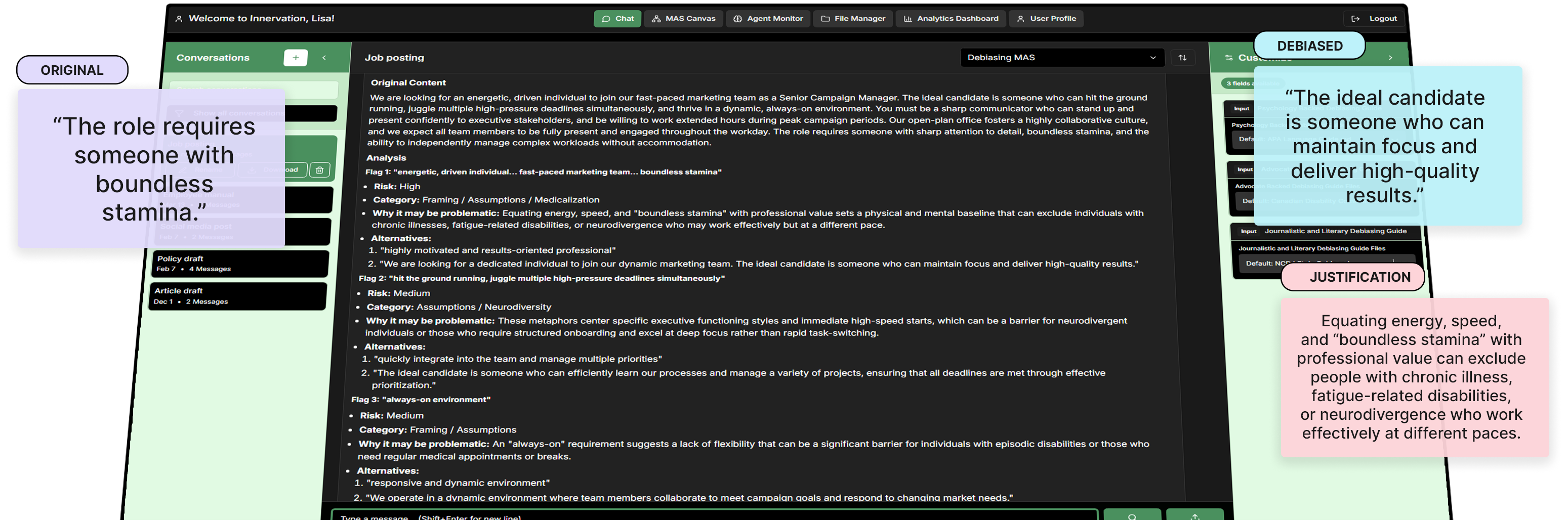
Product Screenshot
Winner: G7 GovAI Grand Challenge
Internationally recognized for advancing responsible AI governance. See recipients

Bias in Language Has
Real-World Consequences

Job postings that unintentionally exclude qualified candidates

Media coverage that reinforces stereotypes

Marketing campaigns that overlook marginalized communities

Public communications that erode trust
Most bias isn't intentional. It slips through reviews.
That's where the Debiaser helps.
Endorsement

“Innervation's AI-powered Debiaser provides a powerful and practical solution to address concerns of ableism, whether within government institutions, corporate environments, or in the everyday experiences of individuals.”
Leading accessibility consultant,
and disability rights activist

What is the Debiaser?
The Debiaser analyzes your written content and flags patterns of bias, exclusion, or unbalanced framing. It provides clear explanations and suggestions so teams can adjust language before publication.
Job Descriptions • Press Releases • News Articles • Policy Documents
Campaign Messaging • Website Content • and more
Use the Debiaser in 3 easy steps:
Write, paste, or upload your content
Submit your content — a job posting, article, campaign, or policy document.
Receive a debiased draft with justifications
Receive flagged areas with clear explanations of why each phrase is problematic.
Review suggested changes and finalize confidently
Approve suggested changes or select alternatives that preserve your voice while removing bias.
Key Features

Bias Detection
Identifies ableist bias and exclusionary language patterns, and flags by risk level (High, Medium, Low).

Context-Aware Analysis
Understands tone, framing, and narrative imbalance, not just keywords.

Explanation Engine
Provides clear reasoning behind each flag, helping your team identify biased language and improve it over time.

Revision Guidance
Offers inclusive alternatives without rewriting your voice.

Benchmarking Tools
Compare your content against national and international best-practice guides and standards for ableism detection.

Reporting & Export
Generate internal documentation for review and accountability.
Use Cases by Audience
Communicate Inclusively
Campaigns, press releases, and brand messaging shape public perception. The Debiaser scans copy before publication so teams can catch unintentional bias and maintain brand integrity.
- Screen campaign copy, social posts, and website content before launch
- Align messaging with organizational DEI commitments
- Build trust with disability communities through respectful language
Benchmarking and Evaluation
The Debiaser benchmarks against leading accessibility and disability language standards and references.
NCDJ Disability Language Style Guide

National Center on Disability and Journalism (Arizona State University)
APA Inclusive Language Guide
American Psychological Association (2nd edition, 2023)
A Way with Words and More
Government of Canada guide for communicating about persons with disabilities
Custom
Additional regional, cultural, or industry-specific guidelines can be integrated
Architecture Overview
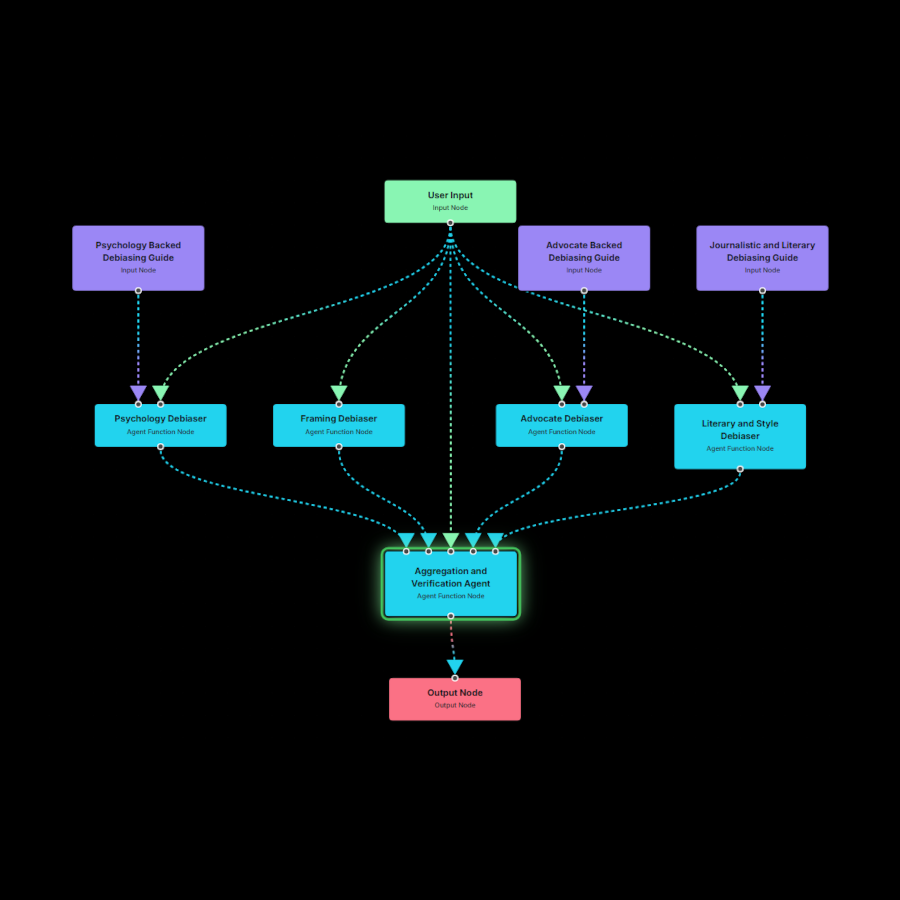
Framing Debiaser Agent
Reads beyond individual words to find hidden assumptions in how a message is structured. Flags language that unintentionally portrays disability in a negative or limiting light.
Psychology, Advocate and Literary Perspective Debiaser Agents
A set of agents that are each given guideline material coming from different perspectives, and each independently compares the input to their standard, critiquing the issues from their unique perspectives. We've found scientific/medical, journalistic/literary, and advocate backed sources to be a useful set as this covers scientific consensus, professionalism, and the preferences of those in a marginalized class.
Aggregation and Verification Agent
Combines insights from the framing agent, as well as the guideline informed agents into one clear report. It double-checks all suggestions, deduplicates overlapping changes and justifications, and delivers a polished output that includes the original text, suggestions and justification for each potential change, and a draft version of the debiased text for the user to refine.
See How It Works
“We're looking for candidates who are ready to hit the ground running in our fast-paced banking environment!”
The APA explicitly lists "hit the ground running" as an ableist idiom to avoid. It relies on a physical metaphor that equates professional competence with physical mobility.
“We're looking for candidates who are eager to contribute immediately to our dynamic banking environment!”
“The difference between those who weather emergencies successfully and those who struggle often comes down to one factor: preparation.”
This phrasing implies that individuals who struggle during emergencies are solely to blame for a lack of preparation. It ignores systemic barriers, poverty, and disability-related challenges that make "weathering" emergencies difficult regardless of preparation.
“Preparation significantly improves the ability to respond effectively, enabling individuals and families to manage challenges more successfully.”
“The fair is an all-day walking event, so wear comfortable shoes and be prepared to spend several hours exploring.”
This phrasing assumes all students have the physical ability to walk for extended periods. The NCDJ warns against language that implies a "normal" body or physical ability.
“The fair is an all-day event, so dress comfortably and be prepared to spend several hours exploring your options.”
Built for Responsible Use
The Debiaser is designed to support human judgement, not replace it.
You stay in control of your content at every step.

Data Privacy
Your content is encrypted and processed on secure servers within your national jurisdiction.

Clear Explanations
Every flag includes a clear explanation and alternatives.

Exportable Reports
Reports are exportable for internal review and accountability.

Transparent Criteria
Transparent, best-practice criteria referenced for every bias detected.
Communicate with Confidence.
Build trust, strengthen inclusion, and reduce reputational risk.
For media inquiries