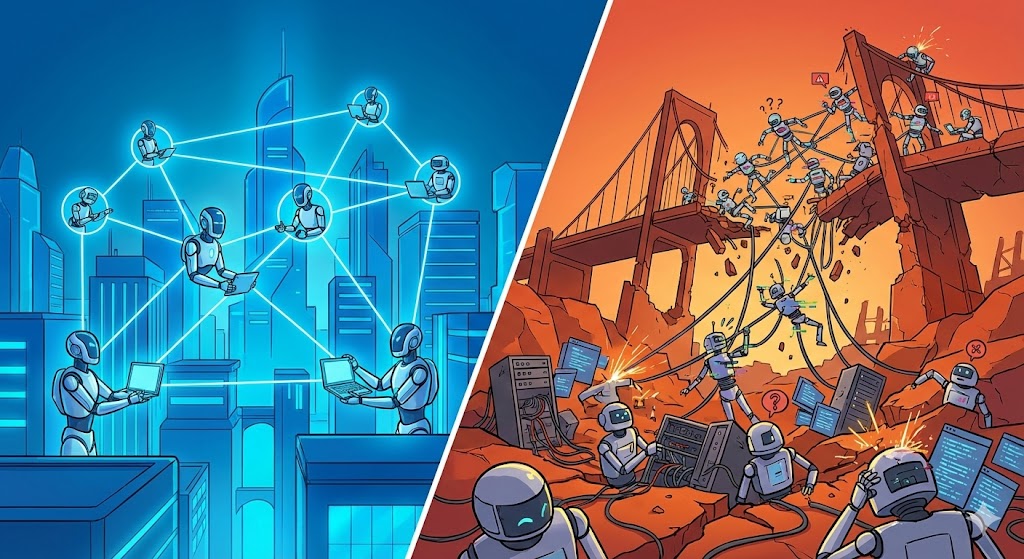
Multi-agent system orchestration carries alarming failure rates. Empirical analysis across seven state-of-the-art open-source multi-agent systems reveals failure rates between 41% and 86.7% [4]. And despite accelerating enthusiasm for agentic AI, implementation realities remain sobering for enterprises trying to scale beyond pilot projects.
Gartner predicts 33% of enterprise applications will include agentic AI by 2028, up from less than 1% in 2024 [2]. Full deployment, however, remains stagnant at 11% [3]. The gap between interest and successful deployment becomes concrete when you examine the economics: a task costing $0.10 in API calls for a single agent can balloon to $1.50 for a multi-agent system due to coordination overhead [3]. Multiplied over thousands of daily tasks, that cost structure undermines any clear ROI.
Enterprise adoption is accelerating on paper. The number of organizations running agentic AI pilots nearly doubled from 37% to 65% in a single quarter [3]. Yet quality remains the dominant barrier: 32% of professionals in a 1,300-person survey cite it as the top obstacle to production deployment [3]. Orchestration frameworks, meanwhile, often produce fragile architectures that lose reliability the moment they scale.
This article examines why the last 20% of implementation becomes the breaking point for most multi-agent projects, and what distinguishes successful deployments from costly failures.
The Paradox of Agentic AI Adoption
Enterprise interest in agentic AI continues to climb, yet 95% of generative AI pilots fail to deliver measurable financial impact [1].
Why interest is surging but deployments are stalling
An MIT study found that only 5% of AI pilot programs achieve rapid revenue acceleration [1]. Agentic AI interest saw a tenfold increase between 2024 and 2025 [2], yet deployment rates have barely moved. Nearly half of all agentic AI projects remain trapped in proof-of-concept, unable to cross into production [3].
Security, privacy, and compliance concerns top the list of barriers, cited by 52% of organizations, with technical scaling challenges close behind at 51% [3]. Across multiple quarters, 65% of leaders consistently identify agentic system complexity as their primary obstacle [4].
Organizations are rarely questioning AI’s potential value. They are struggling with the mechanics of implementation and with how fundamentally different agentic AI is from traditional pipelines and workflows. Seventy percent of agentic AI-powered decisions still require human verification [3], and only 18% of companies are attempting multi-agent or end-to-end approaches [2]. The disconnect between where leaders see agentic systems going and where the operational reality currently sits is persistent and wide.
The illusion of pilot success
Early AI wins often create a dangerous mirage. Promising pilot outcomes, initial productivity gains, and organizational excitement can mask fundamental weaknesses [5]. Many companies treat the presence of AI tools and a few successful experiments as evidence of genuine transformation [5].
Organizations typically anticipate results within 3 to 6 months, yet successful projects generally require 12 to 18 months to demonstrate real business value [5]. Most enterprises approach AI as a plug-and-play solution, expecting immediate returns without addressing structural barriers first [5].
Experimentation stays siloed, cross-functional learning remains limited, and while AI efforts may be structured, they lack the orchestration layer needed to drive toward a cohesive vision [5]. Adoption also stalls when it depends entirely on central AI teams; line managers need to be empowered to drive it forward [1].
The hidden costs of scaling agents
Ninety-six percent of enterprises report that generative AI and agentic automation costs exceed initial expectations [3]. Behind polished demonstrations sit extensive hidden expenses across development, data readiness, orchestration, operations, and scaling [3].
The cost explosion begins with data. High-quality data is the foundation of any agentic system [6], yet many organizations discover their data limitations only after significant investment. Data preparation alone can consume 20 to 30% of total AI budgets in the first year [4].
Technical overhead compounds from there. Complex agents consume 5 to 20 times more tokens than simple chains due to reasoning loops and retries [6]. Infrastructure inefficiencies such as idle resources and over-provisioning lead to 30 to 50% wasted spend [6]. Without optimization, token handling issues alone can quietly double operating expenses [3].
The financial picture extends well beyond technology. Integration with existing systems costs $20,000 to $50,000 depending on complexity [4]. Monitoring, governance, and compliance add $50,000 to $100,000 annually [4]. Security requirements demand another $25,000 to $75,000 per year [4]. What begins as an affordable pilot becomes a cost structure that Gartner expects will force 40% of agentic AI projects to be canceled before reaching production by 2027 [6].
The Last 20%: Where Multi-Agent Systems Break
Behind successful pilot demonstrations, multi-agent systems frequently collapse when facing enterprise-scale demands. These breakdowns cluster in five areas.
Coordination breakdowns
As multi-agent systems scale, communication problems multiply exponentially. Even frontier LLMs demonstrate strong performance with small networks but begin to fail once network size increases [2]. Coordination failures account for nearly 37% of multi-agent system breakdowns [4] [7].
Agents frequently agree on strategies too late during message-passing, or fail to coordinate at all [2]. Without standardized communication protocols, intermediate outputs get misinterpreted, and errors cascade across the workflow [7]. Agents also tend to accept information from neighbors without verification, even when that information is wrong [2]. Blind trust at the agent level amplifies errors through the entire system.
Data architecture limitations
Traditional enterprises typically operate with four separate, incompatible technology stacks optimized for different computing eras, none of which were designed for AI reasoning [1].
Semantic relationships between business entities get lost during integration, and context critical for intelligent decision-making gets stripped away [1]. Centralized data architectures create bottlenecks, slow onboarding, and impair data discoverability as volume grows [1]. Without knowledge graphs to transform disconnected data into connected intelligence, multi-agent systems receive datasets that may be technically clean but remain semantically impoverished [1]. The result is frequent hallucinations and reasoning failures.
Integration with legacy systems
Legacy systems present structural barriers to multi-agent orchestration. Rigid architectures, outdated APIs, and monolithic applications are fundamentally at odds with modern AI frameworks [5]. Security vulnerabilities compound the problem: older systems often lack modern cybersecurity defenses, and integrating AI agents can expose sensitive business data to new risk vectors [5], particularly in regulated industries.
Proprietary systems like SAP intensify these challenges with intricate data models, proprietary logic, and bespoke configurations [5]. Integration costs typically range from $20,000 to $50,000 depending on system complexity [8].
Governance and compliance gaps
Most legacy environments lack the controls needed for AI compliance with regulations like HIPAA, GDPR, or industry-specific standards [5]. The absence of these controls exposes organizations to data privacy risks, biased model outputs, and compliance violations that can halt projects entirely. Organizations must implement the same privacy, security, and compliance controls for AI agents as they deploy for human users [5], including role-based access controls and comprehensive audit trails.
Cost and performance tradeoffs
Multi-agent systems introduce a fundamental tension between latency and accuracy [3]. A single LLM call might take 800 milliseconds; an Orchestrator-Worker flow with Reflection loops can require 10 to 30 seconds [3]. The result is an “Unreliability Tax”: additional compute, latency, and engineering investment required to mitigate failure risk.
Quadratic token growth is the most dangerous economic trap in agent design [3]. As conversations extend, costs accumulate fast. A Reflection loop running 10 cycles can consume 50 times the tokens of a single pass [3]. Unconstrained agents can cost $5 to $8 per task for software engineering issues [3]. Multi-agent systems with unnecessary handoffs and verbose inter-agent updates burn tokens at an even higher rate [6].
Five Failure Modes That Signal Trouble
Empirical analysis of production multi-agent deployments reveals recurring patterns of failure. Between 41% and 86.7% of multi-agent systems fail in production [4], with most breakdowns occurring within hours of deployment. Five failure modes account for the majority of these collapses.
1. Specification collapse
System design issues and poor prompt specifications account for nearly 42% of all multi-agent system failures [9]. The manifestations are specific and measurable: agents disobeying task requirements (11.8%), repeating previously completed steps (15.7%), or failing to recognize when tasks are complete (12.4%) [10].
These problems trace back to ambiguous initial goals or system prompts. Without clear functional boundaries, agents either duplicate effort or override each other’s work [11]. Organizations that treat specifications as loose documentation, rather than rigorous API contracts, inevitably face specification collapse as agents explore multiple interpretations of vague instructions.
2. Context explosion
As conversations extend, multi-agent systems suffer from quadratic token growth that rapidly consumes context windows [12]. Three pressures emerge simultaneously: spiraling cost and latency, signal degradation as relevant information gets buried in noise, and physical limits when workloads overflow even the largest fixed windows [12].
Context engineering becomes especially difficult in multi-agent architectures. When root agents pass full history to sub-agents, and those sub-agents pass it further downstream, token counts skyrocket [12]. The paradox: the more context you add, the less stable the system becomes [2].
3. Integration wall
Even after resolving core algorithmic challenges, multi-agent systems hit integration barriers. Vector databases, embedding models, retrieval APIs, and orchestration frameworks each come from different vendors with distinct and sometimes incompatible formats [2]. Organizations face a difficult choice: lock into a single vendor stack or build fragile integrations that accumulate technical debt [2].
Legacy systems with rigid architectures, outdated APIs, and monolithic applications compound the problem [2]. The fragmented ecosystem that results is one of the largest hidden costs in multi-agent deployments.
4. Accountability blackhole
Without a designated arbiter, whether human or LLM-based, no agent takes responsibility for overall output correctness [11]. Incorrect or incomplete results propagate unchecked. Task verification failures account for 21.3% of multi-agent system breakdowns [9], including premature termination at 6.2% and incomplete verification at 8.2% [10].
Sole reliance on final-stage, low-level checks proves inadequate for complex multi-agent interactions [10]. Multi-level verification is essential, yet organizations frequently overlook it.
5. Observability gap
Traditional monitoring tools were designed for binary success/failure states. AI outputs exist on quality spectrums that demand more nuanced evaluation [7]. Average response times become meaningless when individual requests vary dramatically based on input complexity [7].
Context dependency makes this worse. The same model might handle simple queries well while failing on edge cases [7]. Effective multi-agent observability requires unifying metrics, logs, traces, and events by service, then correlating them to service level objectives so alerts reflect business impact rather than raw threshold breaches [13].
Is Your Enterprise Ready? A 16-Point Checklist
Before investing in multi-agent systems, organizations should evaluate readiness across four dimensions. Nearly 40% of AI projects initiated in the last two years failed to advance beyond pilot phase [14], and much of that failure traces back to gaps in the foundations described below.
Infrastructure maturity
Multi-agent orchestration demands robust technical foundations:
- Scalable compute resources with sufficient CPUs/GPUs to power training and inference at scale [1]
- Vector database flexibility that supports fast, consistent updates as new data becomes available [1]
- Multi-model infrastructure for testing different LLMs against specific use cases [1]
- A hybrid architecture strategy that balances cloud and on-premises deployment based on workload patterns [15]
As AI moves from proof-of-concept to production, recurring workloads create near-constant inference demands [15]. For predictable, high-volume workloads, on-premises deployment becomes economical when cloud costs exceed 60 to 70% of equivalent hardware costs [15].
Governance and access control
Without governance engineered into the infrastructure from the start, multi-agent systems face serious deployment risks:
- Agent identity management that assigns unique managed identities with least privilege access [16]
- Standardized communication protocols with schema validation between agents [16]
- Runtime anomaly detection to catch agents acting outside expected parameters [16]
- Comprehensive audit trails for both internal and regulatory traceability [5]
Eighty-three percent of executives agree effective AI governance is essential, yet only 8% have embedded frameworks to manage AI-related risks [14].
Data readiness and quality
Data readiness goes beyond availability. It requires deliberate, strategic preparation:
- A documented, stable taxonomy with consistent terminology across systems and teams [5]
- Unified metadata standards applied uniformly to content and knowledge assets [5]
- Knowledge graphs that add semantic structure, enabling agents to disambiguate terms [5]
- Hybrid retrieval capabilities that combine structured and unstructured sources in unified pipelines [5]
Without high-quality data, AI multiplies mistakes faster than it multiplies productivity [17]. More than half of business leaders cite data quality and availability as major challenges to accelerating AI adoption [18].
Operational workflows and monitoring
Effective multi-agent orchestration demands comprehensive monitoring:
- Command center functionality with dynamic visualizations and real-time status updates [19]
- An AI registry tracking model versions, prompts, and outputs across the organization [1]
- Repeatable workflows that standardize AI development processes beyond one-off experiments [1]
- Cross-functional oversight involving legal, compliance, and business stakeholders [1]
Those That Succeed: What They Do Differently
The enterprises that get multi-agent orchestration into production share six practices that dramatically increase deployment success rates.
1. Ruthless scope control
Successful organizations start with high-impact, low-risk use cases that address specific business pain points: customer service automation, document processing, routine administrative tasks. These offer measurable returns and give the broader organization evidence that the technology works [20]. The pattern is consistent: pilot a single workflow, define human oversight requirements, and establish clear success metrics before expanding to the next.
2. Orchestrated coordination patterns
Effective multi-agent systems employ structured orchestration patterns. Microsoft identifies five proven approaches: sequential, concurrent, group chat, handoff, and agentic orchestration [21]. Each optimizes for different coordination requirements. Centralized orchestration provides tighter control; decentralized approaches offer greater flexibility [22]. The choice depends on the specific workflow, and selecting the wrong pattern is a common source of avoidable failure.
3. Data-first system design
Organizations with poor data quality face significantly higher implementation failure rates [20]. Successful deployments invest in strong data pipelines before deployment, ensuring real-time access, quality validation, and reliable integration with enterprise systems. Data pipeline failures remain one of the most common causes of AI agents producing incorrect results in production [20].
4. Graduated autonomy levels
Autonomy exists on a spectrum. Most organizations harvest outsized gains from well-governed Level 2 to 4 systems long before pursuing full autonomy [23]. A graduated approach lets teams build confidence and institutional knowledge; human oversight stays in place at each level until the evidence justifies loosening it.
5. Economic threshold modeling
Defining measurable KPIs is essential: accuracy rates (target of 95% or higher), task completion rates (target of 90% or higher), response times, and business impact metrics [20]. Technology costs are only one component. Data preparation, integration, and ongoing maintenance often equal or exceed the initial platform investment, and enterprises that model these costs realistically are far more likely to sustain funding through to production.
6. Governance-as-code practices
Only 17% of enterprises have formal AI governance [20]. Those that do scale agent deployments with measurably greater frequency. Governance-as-Code (GaC) codifies policies directly into infrastructure, which cuts human error and makes compliance portable across environments [24]. At scale, automated validation and monitoring preserve data integrity where manual review simply cannot keep pace.
Conclusion
The gap between pilot success and production deployment in multi-agent systems is wide and well-documented. Failure rates between 41% and 86.7% across production environments, with most breakdowns occurring within hours, confirm that the last 20% of implementation is where most projects fracture. Specification collapse, context explosion, integration barriers, accountability gaps, and poor observability create compounding risk that a successful demo does nothing to address.
The enterprises that do succeed share a common discipline. They begin with ruthless scope control, selecting targeted, high-impact use cases and resisting the urge toward sweeping transformation. They invest in data pipeline quality before deployment, they select orchestration patterns appropriate to each workflow, and they adopt graduated autonomy levels that keep human oversight in place while the organization builds confidence. Economic threshold modeling gives stakeholders a realistic picture of total cost, and governance-as-code practices provide the consistent controls that security and compliance teams require. The 60% success threshold is achievable, but only with methodical preparation across infrastructure, governance, data quality, and operational workflows.
Ready to overcome the last 20%? Let’s discuss how Innervation’s multi-agent orchestration platform can accelerate your path from pilot to production.
Key Takeaways
- 95% of AI pilots fail to deliver financial impact – Most multi-agent projects remain stuck in proof-of-concept due to coordination breakdowns and hidden scaling costs.
- Five failure modes drive the majority of production breakdowns – Specification collapse (42% of failures), context explosion, integration walls, accountability blackholes, and observability gaps. Most surface within hours of deployment.
- Data architecture limitations break multi-agent systems – Legacy environments with fragmented stacks and poor semantic relationships produce frequent hallucinations and reasoning failures in production.
- Enterprises that succeed practice ruthless scope control – They start with high-impact, low-risk use cases, implement governance-as-code, and build data-first architectures before scaling.
- Hidden costs exceed initial expectations for 96% of enterprises – Data preparation, integration ($20K–$50K), and token consumption (5–20x more than simple chains) drain budgets without deliberate optimization.
Frequently Asked Questions
Multi-agent systems fail at scale due to five compounding factors: coordination breakdowns between agents, data architecture limitations in legacy environments, integration challenges with existing systems, governance gaps around compliance and access control, and cost and performance tradeoffs that erode ROI. These issues interact with each other, and the last 20% of implementation is typically where they surface together.
The five critical failure modes are specification collapse (agents misinterpreting or duplicating tasks), context explosion (quadratic token growth consuming context windows), integration walls (incompatible vendor ecosystems and legacy system conflicts), accountability blackholes (no agent or arbiter responsible for output correctness), and observability gaps (traditional monitoring tools unable to evaluate AI output quality). Most of these manifest within hours of deployment.
Data quality is foundational. Poor data leads directly to hallucinations, reasoning failures, and inconsistent outputs. Organizations that succeed invest in data pipelines, quality validation, and semantic structure (such as knowledge graphs) before deploying agents. Data preparation alone can consume 20 to 30% of total AI budgets in the first year.
Six strategies recur across successful implementations: ruthless scope control (starting with targeted use cases), orchestrated coordination patterns (selecting the right architecture for each workflow), data-first system design, graduated autonomy levels, economic threshold modeling, and governance-as-code practices. Each addresses a specific category of deployment risk.
Readiness assessment spans four dimensions: infrastructure maturity (compute, vector databases, multi-model support), governance and access control (agent identity management, audit trails), data readiness and quality (taxonomy, metadata, knowledge graphs), and operational workflows and monitoring (command center functionality, AI registries, cross-functional oversight). A 16-point checklist covering these areas provides a concrete starting point.
References
- DataRobot – Enterprise Path to Agentic AI
- LangWatch – 6 Context Engineering Challenges Stopping AI from Scaling
- Stevens Institute – Hidden Economics of AI Agents
- Augment Code – Why Multi-Agent LLM Systems Fail
- Earley Information Science – From LLMs to Agentic AI
- DataGrid – 8 Strategies to Cut AI Agent Costs
- Braintrust – AI Observability and Monitoring
- Tao – Cost Economics of AI Agents
- The Grigorian – Why Do Multi-Agent LLM Systems Fail
- arXiv – Multi-Agent System Failure Analysis (2503.13657)
- Orq.ai – Why Do Multi-Agent LLM Systems Fail
- Google Developers – Context-Aware Multi-Agent Framework
- LogicMonitor – AI Observability
- IBM Institute for Business Value – AI Infrastructure Report
- Deloitte – AI Infrastructure Compute Strategy 2026
- Dave Patten – Multi-Agent AI: From Experiments to Enterprise
- Workday – Clean Data Is Key to AI Success
- World Economic Forum – Data Readiness as Strategic Imperative
- AutomationEdge – AI Workflow Monitoring
- OneReach.ai – Best Practices for AI Agent Implementations
- Microsoft – AI Agent Design Patterns
- HatchWorks – Orchestrating AI Agents
- Open Data Science – Practical Framework for Agentic AI Levels
- Firefly – Governance as Code