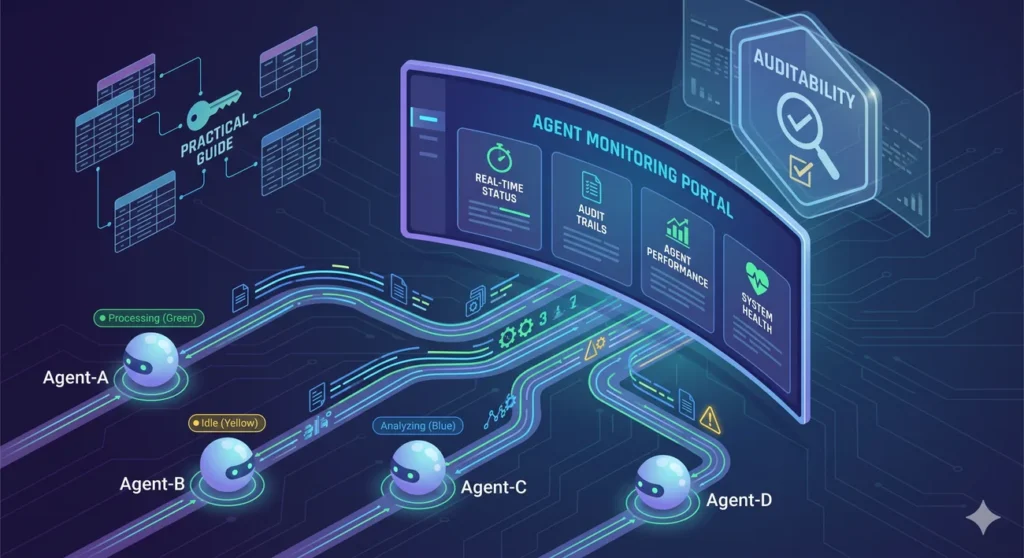
Only 2% of organizations hold their AI agents fully accountable for what those agents do[3]. That number is the visible symptom of a deeper problem: multi-agent deployments produce coordination failures that no single monitoring system catches, decision chains that no human can reconstruct after the fact, and emergent behavior that breaks policies nobody wrote the agents to break.
The distance between how fast organizations deploy autonomous agents and how well they can govern them has become the reason most of these projects stall. Teams race to put agents into production, then discover their audit frameworks stop at the orchestration layer. Business-critical decisions end up locked inside black boxes that satisfy no regulator and explain nothing to the people who have to answer for them.
The cost is quantifiable. Multi-agent systems can demand up to 26 times the monitoring resources of a single agent, driven by the quadratic growth in interaction paths as agents coordinate[3]. Policy-as-code enforcement cuts compliance violations by roughly 90% against reactive monitoring by blocking non-compliant actions before they execute[13]. Complete audit trails capture upward of 99% of agent actions in immutable, timestamped records[2]. None of that can be retrofitted cleanly.
This guide walks through why the accountability gap exists, the four infrastructure capabilities auditable systems need, the governance architecture that ties them together, and the instrumentation that survives contact with production. The organizations that embed auditability into coordination from day one report fewer compliance violations and faster incident resolution than the ones bolting monitoring on afterward.
The Auditability Crisis in Production Systems
Production multi-agent systems break at the governance layer. Misrouted transactions, decisions no one can explain, coordination that quietly violates business policy: these are the failures that turn into real operational risk. Eighty percent of AI projects never reach production[3], and the gap between what the technology can do and what an organization can account for is a large part of why so many multi-agent efforts stall at proof-of-concept.
The pattern is consistent enough to be predictable. Governance frameworks end where deployment begins. Traditional monitoring captures system performance and misses the distributed reasoning that actually drives business outcomes. Agent-to-agent handoffs, emergent coordination, and decision chains that thread through several reasoning entities all stay invisible to conventional observability tooling.
What you decide about architecture now sets the ceiling on what you can audit later. Position governance at the orchestration layer and auditability is solved before it becomes an obstacle to scale. Leave it for a later sprint and you inherit black boxes that fail audits and create compliance exposure you cannot measure.
Most organizations deploy agents without decision infrastructure
Only 2% of tech leaders report that their AI agents are held fully and consistently accountable for their actions[3]. That figure points at an architectural failure, not a policy oversight: autonomous systems shipped without any means to trace what they did or why. Reconstructing the logic behind a single action becomes practically impossible once the decision has passed[10].
Coordination compounds the problem. One agent processes an input and passes its conclusion to the next, which treats that conclusion as an established fact. Downstream agents then build on assumptions no one can trace back to a source. An early error propagates through the chain and hardens into a system-wide conclusion, with nothing in place to surface the flawed reasoning that started it.
Then there is the ownership question. Developers write the agent code, data teams supply the training inputs, infrastructure teams handle deployment, and users shape behavior through their interactions. When the system produces a bad outcome, no single party owns it end to end[10]. Every component stays inside its own technical spec while the collective result violates the business intent none of them was responsible for holding.
Emergent behaviors that no one designed
Multi-agent systems produce outcomes larger than the sum of their agents. Emergent behavior appears when agents following local rules interact in ways that generate system-level patterns no designer planned for[3]. The closest everyday analogy is a phantom traffic jam: individual drivers each following simple rules produce a standstill with no crash and no obvious cause[3].
In production, emergence shows up as policy drift, context leakage, and failures that leave no obvious trace[5]. Picture a refund agent coordinating with a collections agent through a standard interface. Each executes its own function correctly. Their combined logic hands the customer a contradictory experience, and the responsibility for it lives only in the space between two systems that no single team controls.
Context sharing widens the exposure. Teams enrich data schemas with customer sentiment, demographics, or behavioral signals to make agents more capable, and that enriched context then flows to every downstream agent in the workflow, sometimes across vendor boundaries, often without anyone explicitly authorizing it[5]. A model version update can do something similar. Agent behavior shifts when the underlying model changes even though the declared capabilities look identical, so the interface contract appears stable while the decision logic underneath it drifts, producing ghost failures that conventional monitoring never registers[5].
Governance gaps generate measurable costs
More than two-thirds of technology leaders deploy several agent use cases before they establish any framework to govern them[10]. That ordering creates operational debt that is expensive to unwind. Multi-agent systems can require up to 26 times the monitoring resources of a single-agent deployment[5], because operational complexity scales quadratically. Each new agent multiplies the interaction paths and the failure modes along with them.
The bill arrives as inconsistent customer experiences, failed compliance audits, decision trails that cannot be explained to a regulator, and engineering hours burned firefighting behavior nobody anticipated[7]. These failures rarely announce themselves as crashes. They surface as anomalies where the technical monitoring reads healthy while the business outcomes quietly degrade[5].
Governance gaps also open security and regulatory exposure that leadership cannot even assess[10]. Absent proper oversight, an organization has no reliable way to know whether its agents are reaching sensitive data appropriately, sharing information across boundaries they should not cross, or making choices that break internal policy. Agent proliferation moves fast, and the consequences of ungoverned behavior compound at the same rate[10]. You cannot audit a system you do not know is running.
Infrastructure Requirements for Auditable Multi-Agent Systems
An organization cannot audit what it cannot observe, and most discover this only after deployment, when a regulator asks for evidence that was never captured. Building auditable multi-agent systems means embedding four capabilities into the orchestration architecture from the first day of design.
Complete Decision Provenance: From Inputs to Final Outputs
Auditable AI maintains an unbroken chain from any agent output back to the original inputs and every processing step in between[3]. This is more than event logging. Provenance tracking builds directed acyclic graphs whose nodes represent process invocations and data states and whose edges capture the transformation dependencies between them[6]. The architecture records not only what changed but how and why each transformation happened[6].
Decision context is the foundation layer. Every agent action needs proof that the decision drew on appropriate, authorized data and not on incomplete or compromised information[6]. In practice that means capturing the complete state at decision time: the data sources accessed, the instructions active, the conversation history, and the environmental constraints in force[7]. Once working memory is overwritten, reconstruction without that persistent context is no longer possible[7].
The reasoning chain supplies the step-by-step logic that shows an agent followed a defensible process, not an arbitrary one[6]. Rule-based systems trace their policy evaluations through decision trees. ML-based agents capture model outputs, confidence scores, and fallback logic[7]. Logging the alternatives an agent considered demonstrates that it weighed several options before it acted, and did not simply default to a preprogrammed response[6].
Agent Coordination Visibility: Capturing Distributed Decision-Making
Multi-agent systems break the assumptions traditional audit rests on. When one agent delegates to another and spawns autonomous sub-tasks, there is no single decision owner to point to[3]. The original instruction can vanish three coordination layers deep, with no human watching and no individual agent holding end-to-end responsibility[3].
Distributed tracing addresses this through a consistent instrumentation hierarchy: sessions capture the full user journey, traces represent complete agent workflows, and spans record the individual operations inside them[10]. Each span has to document prompts, variables, tool calls, retrieval context, outputs, and performance metrics for the visibility to be complete[10]. Handoffs deserve particular attention. Which instructions, context, and constraints actually transferred between the agents? Most handoffs go undocumented, which leaves auditors holding outputs with no custody chain behind them[3].
State transition histories track how agent memory, context, and environment change across the life of a workflow[5]. That record exposes coordination patterns, pinpoints processing bottlenecks, and shows exactly where a reasoning path diverged or collapsed[5].
Compliance Evidence Generation: Meeting Regulatory Requirements
Regulatory frameworks name their evidence requirements explicitly. The EU AI Act requires high-risk systems to maintain logging sufficient for post-market monitoring and incident investigation[7]. SOC 2 concerns itself with whether controls operate consistently as documented over a sustained period[6]. GDPR calls for documented personal-data access patterns, purposes, retention periods, and processing activities[7].
Policy evaluation records are what prove runtime governance is doing its job. For every decision of consequence, the system logs whether the action was permitted, blocked, or flagged, along with which specific policies applied and how they resolved[7]. That produces verifiable proof that agents operated inside their defined boundaries, which is a different thing entirely from a compliance assertion with nothing behind it.
Immutable Audit Trail Architecture: Tamper-Proof Evidence
Audit credibility depends on logging that cannot be altered after the fact. Every entry needs cryptographic timestamps and tamper-evident sealing to hold up under regulatory scrutiny[3]. The system should be able to generate governance reports for any specified timeframe, showing complete agent activity down to the policy evaluations and their outcomes, without pulling an engineer off other work to assemble it[7].
Complete coverage means capturing more than 99% of agent actions for regulatory purposes[2]. That spans agent identity verification, authentication events, decision reasoning chains, data access and modification, user interactions, authorization levels, system integrations, and API calls[2]. Storage has to stay isolated from production systems, with retention windows of three to seven years depending on what the regulation specifies[2].
The four capabilities depend on one another. An immutable trail with no provenance behind it records events you cannot interpret, and provenance with no coordination visibility misses the handoffs where distributed failures actually originate. Together they turn opaque agent systems into infrastructure an organization can defend under audit.
Architecture of Auditable Multi-Agent Systems
Retrofitting monitoring onto a deployed agent system does not work, because audit requirements are supposed to shape infrastructure decisions, not trail behind them. Organizations that implement a three-tiered governance framework report cutting governance overhead by 40% against one-size-fits-all controls[1].
Five-Layer Governance Stack
Governance in a production multi-agent system belongs in the architecture, not in a layer applied after the fact. The stack starts with execution sandboxing that isolates agent actions inside controlled environments[4]. Layer two handles intent verification, where LLM judges intercept between 93.0% and 98.5% of malicious tool calls before they run[4]. The third layer enforces zero-trust inter-agent authorization: every cross-system interaction authenticates on its own and inherits no trust from the orchestration layer.
Layer four captures every decision with full context in an immutable log. The fifth layer takes on coordination failure directly, using formal mechanisms that prevent deadlocks and race conditions across multi-agent workflows[11]. Skip the layered approach and monitoring stays reactive, catching problems only after they have already propagated.
Cascaded Runtime Governance
Runtime governance runs through three evaluation tiers that trade off speed against scrutiny. Tier 1 answers binary questions in microseconds: is this action in scope, and does the agent have explicit authority for it[12]? Anything that clears Tier 1 moves to Tier 2, where scoring engines combine signals across governance dimensions into a confidence score and settle most decisions in under a millisecond[12].
The ambiguous cases escalate to Tier 3 for contextual judgment that weighs trust trajectory, historical precedent, and risk patterns[12]. Simple decisions stay fast; complex ones get the attention they need. Organizations that run a flat governance model instead report 40% higher latency on routine decisions, because every decision pays the cost of the hardest case.
Policy-as-Code for Proactive Enforcement
Policy-as-code stops violations before execution rather than catching them afterward. It compiles governance rules into executable, machine-readable policies that block non-compliant actions at the orchestration layer[13]. Teams that adopt this approach report roughly 90% fewer compliance violations from human error[13].
The implementation rests on three components operating together: a context aggregator that collects request metadata, a policy evaluation engine that processes the conditional logic, and an enforcement engine that carries out allow, block, or approval decisions[15]. Policies compile at deployment time, and with caching and parallel evaluation the latency for simple policies stays under 10 milliseconds[15]. Reactive monitoring cannot match that profile.
Enterprise Observability Architecture
Observability spans four mandatory layers, each capturing a different facet of agent behavior[16]. Application-level tracking follows end-to-end multi-agent workflows and orchestration patterns. Session-level monitoring tracks individual agent journeys and surfaces loops, re-routing, and drift from expected behavior. Decision-level observability exposes reasoning paths, confidence levels, and rejected options. Tool-level monitoring records every API call, database query, and parameter drift[16]. Agent frameworks integrate with OpenTelemetry, emitting traces, logs, and metrics under the GenAI Semantic Conventions so the diagnostic picture stays coherent across systems and does not fragment into disconnected pieces[17].
Model-Agnostic Governance Infrastructure
Governance infrastructure has to outlast any individual model deployment. A model-agnostic architecture separates orchestration logic from model-specific assumptions, which turns model choice into a configuration decision instead of an architectural commitment[18]. Routing layers direct tasks by cost, latency, capability, and compliance requirements without coupling the workflow to any one provider[18]. Agents can then switch or upgrade without a rebuild of the coordination infrastructure, and governance continuity holds as foundation models evolve[18]. Organizations that couple governance tightly to a specific model absorb reconstruction costs every 12 to 18 months as the landscape shifts under them.
See how Innervation embeds auditability into multi-agent orchestration from day one, giving your organization complete decision traceability instead of a monitoring layer you have to reconstruct after every model change.
Instrumentation That Survives Production Reality
Most instrumentation work fixates on what to capture and ignores what makes capture possible when the system is failing. Production multi-agent systems run under conditions that break naive logging: agents spawn sub-processes faster than the monitor can register them, reasoning chains branch across simultaneous model calls, and a coordination failure scatters partial traces across systems that were never designed to talk to each other.
Chain-of-Thought Logging Beyond Model Outputs
Chain-of-thought logging turns opaque AI behavior into an auditable sequence of decisions[8]. The standard approach records final outputs and loses the reasoning that produced them. Effective instrumentation captures the intermediate steps: the document retrieval queries and their results, inference generation with confidence scores, tool selection logic together with the rejected alternatives, and the branching points with the contextual factors that tipped each one[8].
Take an agent analyzing financial reports. The final recommendation is meaningless without the logic underneath it: which metrics it pulled, how it compared cost centers, which trends drove which conclusions[8]. Most implementations fall short here because they instrument the output and never capture the pathway that generated it. Each reasoning step also needs identity-bound metadata: agent identity and authorization scope, tenant context and data boundaries, millisecond-precision timestamps, and session correlation across distributed components[8]. Strip that metadata away and the reasoning chain cannot be rebuilt when the questions start.
Distributed Tracing for Multi-Agent Coordination
Distributed tracing delivers end-to-end visibility as a request moves through gateways, retrieval services, model routers, and external tools[19]. The hard part is holding trace continuity when an agent spawns an autonomous sub-workflow that runs outside the original request context. Session-level observability groups related traces across a conversational sequence and captures coherence drift, context retention failures, goal achievement, and coordination breakdowns[19][21]. Handoffs need dedicated spans that document the instruction transfer, context preservation, constraint propagation, and authorization boundaries[20]. Most tracing implementations break precisely at these handoff points, because the agents run in separate memory contexts on independent execution threads and correlation falls apart once the original trace context fragments.
Tool Execution and State Transition Auditing
Tool call tracing has to record more than the request and the response. Production systems need tool identification with version metadata, input parameters and their validation results, execution results including partial failures, error conditions paired with the recovery actions taken, and execution metadata covering latency, retries, and status codes[20]. State transition histories track how agent memory and environment change across the workflow lifecycle[5]; memory modifications, context window updates, authorization level changes, and environment state transitions all need immutable logging for reconstruction to be possible.
Quality Metrics That Matter for Compliance
Step completion checks whether an agent followed the expected workflow in the correct order[9]. Tool selection metrics confirm the agent chose appropriate tools with valid parameters[9]. Faithfulness measures whether the outputs align factually with the context and input data[9]. These metrics establish that an agent operated within its defined parameters rather than arriving at a plausible-looking answer through a process no one can see. Compliance auditors want evidence of controlled behavior, not just a successful outcome.
Compliance Checkpoints and Escalation Mechanisms
Automated evaluators attach a confidence level to their quality assessments across predefined dimensions[22]. Low-confidence cases route to a human who validates the assessment and supplies ground truth[22]. Business-critical interactions warrant that oversight regardless of what the automated confidence score says[22]. The escalation architecture is what determines audit defensibility. A system that cannot prove when and why a human stepped in will not survive regulatory scrutiny once an automated decision produces an outcome no one is willing to defend.
Implementation Architecture: Building Systems That Work in Production
Most organizations treat multi-agent governance as a policy problem when it is, at root, an architecture problem. The infrastructure you commit to now decides whether your agents run as controlled systems or as expensive black boxes that fail their audits.
Build Versus Buy: An Architecture Decision
Your orchestration choice reflects operational reality more than any feature list[23]. Salesforce and ServiceNow ship pre-built agents with native integration, but they hold scope to a single system and give up cross-workflow visibility in the process[24]. Custom orchestration hands you control over data flows, security boundaries, and cross-system coordination, at the price of significant engineering effort and an ongoing maintenance burden[24]. The trade-off is architectural before it is financial. Bought solutions do well for contained, departmental workflows. Built solutions become necessary the moment agents have to coordinate across security boundaries or audit requirements demand complete decision traceability. Most organizations settle on a hybrid: bought where the tasks are predictable, built where the workflow is differentiated[24].
Platform Evaluation Through Production Constraints
Production platforms fail when they cannot handle tool failures, incomplete inputs, and variable model responses gracefully[23]. A demo shows the happy path; production demands retries, timeouts, and full traceability at the moment something breaks. Governance capability is what separates a platform from an experiment. Enforceable policies, approval gates, and complete audit trails have to operate at runtime, not as afterthoughts[23]. Observability should surface end-to-end traces, cost visibility, and error analytics without anyone resorting to log archaeology[23]. Integration security should treat tool execution isolation, secrets management, and least-privilege access as native features, not bolt-ons[23].
Staged Autonomy Deployment Model
Production systems earn autonomy in stages. Suggest mode has agents draft outputs for human approval. Partial automation takes on low-risk actions directly while escalating the edge cases. Full automation comes only after stability has held across representative workloads[23]. The progression lets an organization validate its governance framework under controlled conditions before it widens agent authority, and it leaves a fallback in place for when a coordination pattern fails or model behavior shifts without warning.
Teams that adopt comprehensive agent debugging report resolving issues 70% faster than teams working from logs alone[25]. Production deployment also calls for adversarial testing that injects failures and timing anomalies to expose coordination problems before real traffic ever hits them[25]. The architectural choices you make this year set how much operational freedom your agent programs carry for the next five.
Conclusion
Multi-agent systems deliver autonomy, and the moment a regulator, an auditor, or a customer asks a question you cannot answer, that autonomy turns into a liability. The governance infrastructure you build now is what decides which of those two things you end up holding. Policy-as-code enforcement, layered observability, and model-agnostic orchestration are the pieces that move governance out of the afterthought category and into a design principle the rest of the system is built around.
The evidence points one direction. Organizations that embed auditability into the coordination layer report fewer compliance violations and faster incident resolution than the ones bolting monitoring onto workflows that were never designed to carry it. The work is front-loaded and the payoff compounds, which is exactly the opposite of the retrofit path, where the cost compounds and the payoff never quite arrives.
Ready to move past black-box agents and stand up an orchestration layer your stakeholders can actually trust? Let’s talk about how Innervation’s auditable platform fits your governance requirements.
Key Takeaways
- Accountability is nearly absent at scale – Only 2% of organizations hold their AI agents fully accountable, and most deploy multiple agent use cases before any governance framework exists to manage them.
- The cost curve is quadratic – Multi-agent systems can demand up to 26 times the monitoring resources of a single agent, because each added agent multiplies interaction paths and failure modes instead of adding them one at a time.
- Prevention beats detection – Policy-as-code enforcement blocks non-compliant actions before execution and reports roughly 90% fewer compliance violations than reactive monitoring, with sub-10ms latency for simple policies.
- Four capabilities are non-negotiable – Decision provenance, coordination visibility, compliance evidence generation, and immutable audit trails have to be embedded together; any one missing undermines the other three.
- Model-agnostic design protects the investment – Decoupling governance from specific models spares organizations the reconstruction costs that otherwise recur every 12 to 18 months as foundation models turn over.
Frequently Asked Questions
Effective monitoring combines system-level telemetry with behavior-level signals: event logging and tracing that capture every task, tool call, and decision step inside the agent’s reasoning loop, plus distributed tracing across sessions, traces, and spans. Each span should record prompts, variables, tool calls, retrieval context, outputs, and metrics so the workflow is visible end to end and not just at its edges.
Four failure categories account for most of it: specification ambiguity where agents misread their instructions, organizational breakdown from distributed development with no clear ownership, inter-agent conflict and coordination gaps that spawn emergent behavior, and weak verification that lets errors propagate undetected through handoffs and decision chains.
Regulated sectors like fintech and healthcare, where explicit audit-trail requirements already exist. B2B SaaS companies belong on the list too, particularly operations and revenue teams whose agents move across CRM, ticketing, and billing systems where every action carries audit risk. The general rule: any organization running agents that make decisions affecting customers or sensitive data needs accountability and reversibility built in.
The complete decision context. That means the data the agent accessed, the instructions in effect, and the conversation history at decision time, together with the user prompt and its context, the structured reasoning steps, tool selection with parameters and outputs, the final response, and authorization metadata covering agent identity, tenant context, and scope, all carrying immutable timestamps.
Scale is the headline problem: multi-agent systems can require up to 26 times the monitoring resources of a single agent because interaction paths grow quadratically. Underneath it sit the harder structural challenges, including the absence of a single decision owner when agents delegate autonomously, emergent behaviors no individual agent was programmed to produce, and the policy-as-code and observability infrastructure most teams never built into their orchestration layer to begin with.
References
- Innervation AI
- Stack AI – The Complete Guide to AI Agent Observability and Monitoring
- Boomi – How to Navigate the AI Agent Governance Gap
- Infosys BPM – Agents in AI: Ethical Considerations, Accountability and Transparency
- Milvus – What Is Emergent Behavior in Multi-Agent Systems
- O’Reilly – AI, A2A, and the Governance Gap
- Lumenova – Taming Complexity: Governing Multi-Agent Systems Guide
- Centific – Why Multi-Agent Systems Fail in Production and How Enterprises Can Avoid It
- TechAhead – Is Your Multi-Agent System Ready for a Compliance Audit
- MITRE – Practical Provenance Guide
- IBM – Building Trustworthy AI Agents: Compliance, Auditability, Explainability
- DEV – Your AI Agents and the Audit Trail: What Compliance Actually Needs
- Medium – Context Graphs: Why AI Agents Need a New Kind of System of Record
- NexaStack – Agentic AI Traceability
- Medium – Debugging Complex Multi-Agent Systems: Best Practices for Observability
- Maxim – Agent Tracing for Debugging Multi-Agent AI Systems
- MintMCP – Enterprise AI Agents: Compliance Ready
- MintMCP – Agentic AI Governance Framework
- arXiv – Governance Architecture for Autonomous Agent Systems: Threats, Framework, and Engineering Practice
- Hendricks.ai – AI Agent Governance Architecture
- LinkedIn – Three-Tier Governance Architecture Changes Everything
- NexaStack – Agent Governance at Scale
- Airia – Agent Constraints: A Technical Deep Dive Into Policy-Based AI Agent Governance
- DataRobot – Agentic AI Observability
- Microsoft Learn – Agent Framework Observability