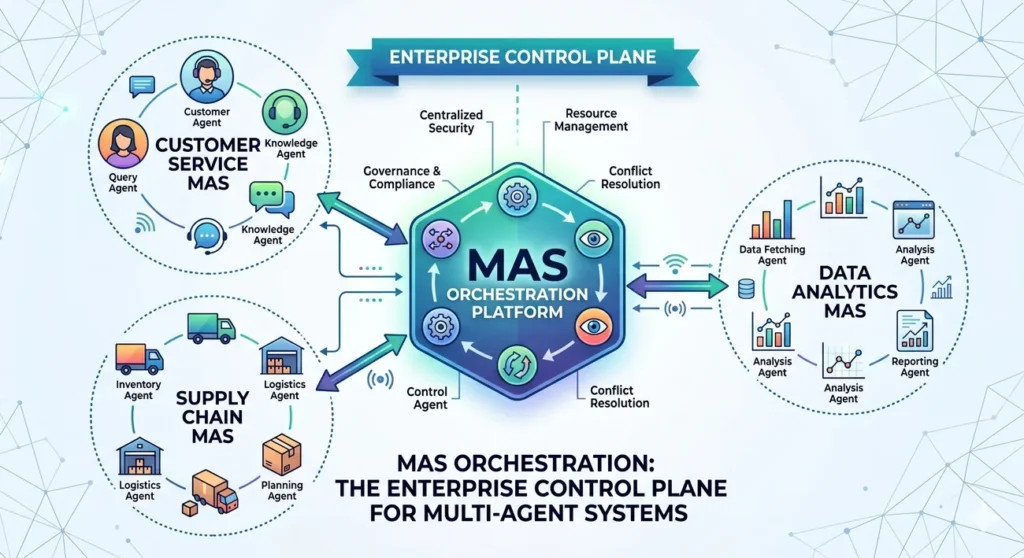
Multi-agent orchestration has crossed from experimental technology into production infrastructure, and the organizations deploying coordinated agent ecosystems report returns that isolated AI tools cannot produce. The pattern is consistent across sectors: banking institutions achieve 60% productivity gains, supply chains compress processing cycles from days to seconds, and customer service operations post 25-60% efficiency improvements, all through specialization that a single general-purpose model cannot match.
The timing is not arbitrary. 2026 is the enterprise inflection point, because interoperability standards have matured, 33% of enterprise software will include agentic AI by 2028, and the organizations that begin structured implementation now are the ones that avoid a competitive disadvantage later. The architectural argument underneath is measurable too: in Anthropic’s internal evaluations, coordinated multi-agent architectures outperformed a monolithic single-agent system by 90.2%, distributing specialized capability across focused agents where general-purpose AI hits the limits of its design.
None of this is free, and the risk profile is the other half of the story. Production deployment runs 12 to 18 months through a structured path of foundation building, framework selection, topology design, and closed-loop autonomy development with governance controls. Scale then introduces systemic risk: development costs reach $200,000 to $500,000, 40% of pilots fail within six months, and communication overhead becomes a performance bottleneck without the right architecture.
The organizations positioning for the $450 billion in economic value projected by 2028 have to move past isolated AI tools toward orchestrated ecosystems, and the architectural choices they make now determine their competitive position once autonomous systems become standard enterprise infrastructure. This analysis covers how orchestration functions as that infrastructure, the production ROI it delivers, and the implementation strategy for building multi-agent systems that actually hold up.
### Introduction
Multi-agent orchestration faces an adoption paradox. AI agents project $450 billion in economic value by 2028[13], and yet executive confidence in autonomous agents fell from 43% to 22% in a single year[13]. At the same time, orchestration already operates within 40% of enterprise applications[11], and the global market will reach $30 billion by 2030[11]. The distance between deployment velocity and control mechanism is where the immediate architectural risk lives. An organization cannot audit what it cannot see, and most multi-agent implementations run without visibility into their coordination patterns, failure modes, or decision pathways. What follows examines how orchestration functions as enterprise infrastructure, the production ROI organizations achieve, and the implementation strategy for building multi-agent systems that deliver 25-60% efficiency gains[11] while holding operational control.
Enterprise AI Adoption Has Stalled at the Orchestration Layer
Deployment Fragmentation Constrains Returns
Only 2% of organizations have deployed AI agents at full scale, with 12% at partial implementation[11]. Another 23% run pilot programs, and 61% remain in exploratory phases[11]. Those penetration rates expose the infrastructure gap directly: enterprises deploy isolated chatbots for customer service, standalone recommendation engines for e-commerce, and task-specific assistants scattered across departments with no coordination and no shared context.
The adoption velocity tells a more encouraging story than the penetration rate does. Organizations using AI agents jumped from 10% to 14% in a single year, a 3.5x acceleration that mirrors how generative AI took hold[11]. That momentum stalls the moment a task-specific agent hits its performance ceiling against a workflow with multiple decision points, data sources, and business rules. Gartner projects that by 2027, 70% of multi-agent systems will deploy agents in narrow, specialized roles[14], and specialization improves accuracy while demanding sophisticated orchestration to coordinate action across distributed systems. The shift from isolated agents to orchestrated ecosystems is a technical necessity, because a monolithic agent cannot carry the workflow complexity enterprise operations actually require.
The Economic Case for Coordinated Intelligence
The gap between coordinated and limited deployment is stark in the projections. Organizations implementing AI agents at scale project average gains of $382 million over three years, against $76 million for those with limited deployment[11]. Capgemini’s analysis forecasts that AI agents will generate $450 billion in economic value by 2028 through revenue growth and cost savings[5], and the early results support the trajectory: surveyed organizations expect $19 billion in gains over 12 months, escalating to $92 billion by year three[11].
The performance data reinforces the economics. Companies using multi-agent workflows with Model Context Protocol report 10x productivity gains in specific processes[16], and early adopters show 20-30% faster workflow cycles alongside substantial back-office cost reductions[17]. The competitive gap widens quickly, with 93% of leaders believing that organizations scaling AI agent orchestration within 12 months will secure a lasting advantage over their peers[11]. All of these returns assume the structured deployment of coordinated systems, not a collection of standalone tools, because without orchestration an organization simply accumulates AI capabilities that cannot communicate, share context, or coordinate a decision.
Why 2026 Determines the Winners
Three factors converge to make 2026 the architectural inflection point. First, interoperability standards like the Agent-to-Agent protocol and Model Context Protocol matured enough for cross-vendor collaboration[16]; without them, enterprises built isolated AI features, and with them, an agent workflow can span systems, vendors, and data sources. Second, Gartner predicts that 15% of daily work decisions will become autonomous through agentic AI by 2028, up from nearly zero today[14], and reaching that threshold makes 2026 and 2027 the foundational years for moving past experimental use cases toward integrated systems where specialized agents extract data, validate against business rules, and route exceptions collaboratively.
Third, the software itself is changing underneath the market. By 2028, 33% of enterprise software applications will include agentic AI, up from less than 1% in 2024[19]. A 33-fold increase across four years demands architectural planning now, because the orchestration layer becomes as critical as the agents themselves, deciding whether AI capabilities operate as isolated tools or as coordinated intelligence that scales with organizational complexity.
Multi-Agent Orchestration as Enterprise Infrastructure
Enterprise AI adoption has opened an infrastructure gap. Organizations deploy agents with no coordination layer, then hit a wall when a workflow needs multiple decision points, data sources, and business rules working together. The orchestration layer closes that gap by functioning as the central nervous system that coordinates every AI component.
What Multi-Agent System Orchestration Actually Does
AI agent orchestration operates as the infrastructure layer governing which agents execute for which tasks, managing the logistics of permissions and connectivity[7]. The orchestrator is a central coordination component that manages request and response flows throughout the system, providing unified management that ensures appropriate routing, maintains context, and handles lifecycle operations[8]. When you submit a task, the orchestrator analyzes the request, breaks it into smaller tasks, delegates each to the right specialist agent, and synthesizes their outputs into a coherent response[9].
That coordination mechanism is what turns isolated AI capabilities into goal-driven systems. The orchestrator translates a high-level objective into an executable workflow, manages task dependencies and execution order, and allocates workload across agents while enforcing priorities and service-level agreements. When conditions change, whether that is a demand spike, degraded agent performance, or an external system failure, the orchestrator adjusts execution paths dynamically, reroutes failed tasks, and recalculates priorities.
The difference from a single-model approach is fundamental. Where one general-purpose AI struggles with a complex workflow, orchestration deploys specialized agents focused on specific tasks[10]. Anthropic’s research demonstrates the advantage concretely: a multi-agent architecture with Claude Opus 4 as lead agent and Claude Sonnet 4 subagents outperformed single-agent Claude Opus 4 by 90.2% on internal evaluations[35], because distributing work across agents with separate context windows enabled parallel reasoning that a single agent cannot do.
Integration, Automation, and Management Components
The orchestration layer is built from several integrated components working in concert. Workflow engines convert user intention into a practical plan, breaking a request into granular tasks, setting dependencies, and determining execution order[6]. Task schedulers regulate the timing and distribution of that allocation, controlling dependencies by selecting when and which agent performs each task[6].
The governance and communication layers sit alongside them. Policy engines enforce security protocols and governance rules throughout the workflow, applying role-based access controls and audit trails so agents operate inside predefined regulatory boundaries[6], and feedback loops drive continuous improvement by feeding execution data, outcomes, and failure patterns back into the system to refine future behavior[19]. Communication infrastructure standardizes the protocols and message formats that underpin agent interaction and information exchange[6], and through that backbone agents share context, divide tasks, synchronize action, and resolve conflicts. Agent registries hold persistent stores of agent metadata, capability, and operational history, covering endpoints, security credentials, performance metrics, and version history[8].
How Orchestration Differs from Isolated AI Deployments
A single-agent architecture consolidates logic, context, and tool execution into one entity, which simplifies implementation and limits capability[13]. Multi-agent orchestration introduces the coordination patterns that handle complex, collaborative tasks through specialization[14], where each agent focuses on a domain like finance, healthcare, or coding, or on a function like summarization or research, applying specialized knowledge to the request[8].
Orchestration also supplies governance structures that an isolated deployment lacks. Without orchestration, an autonomous agent risks becoming a volatile system[7]. The orchestration layer provides sandboxing, usually containerized environments, which gives agents creative autonomy without putting host system integrity at risk[7]. Questions like “how do we isolate runtime so credentials don’t leak?” and “how do we scale to 1,000 concurrent jobs without hitting API rate limits?” become manageable through proper orchestration design[7].
State management is the other critical difference. An orchestrated system maintains context across agent boundaries to preserve conversation flow and data integrity[13], while an isolated agent has no such continuity and is forced into redundant processing and context reconstruction on every interaction. Most enterprises discover this requirement only after their isolated agents have already hit a performance ceiling, at which point the architectural fix is expensive.
Production Deployments Generate Measurable Returns
Multi-agent orchestration produces business outcomes that justify its architectural complexity. The organizations running coordinated agent systems report gains measurable in dollars saved and hours returned, not theoretical productivity.
Supply Chain Operations: Days to Seconds
Supply chain orchestration requires coordination across data-quality agents, alert systems, and execution workflows operating inside defined guardrails, which a single-agent system cannot achieve[11]. Specialized agents handle data validation, exception routing, and autonomous execution at the same time, compressing cycle times from days to seconds[11]. The gains come from parallel processing that a monolithic approach cannot match: where a traditional system processes supply chain events one after another, orchestrated agents validate data quality, assess business rules, and execute decisions concurrently, and the autonomy comes from that coordination, not from isolated automation[11].
Banking: 60% Productivity Improvements in Loan Processing
Financial institutions applying agent orchestration to loan verification report workload reductions of 40-60% through instant ID validation, salary extraction, and account-stability analysis[15]. One regional US bank cut document processing from 14 hours per file to 3.5, generating $2.1 million in annual savings at 250% ROI over 24 months[16]. The operational change goes past the time saved. Loan officers now handle 5,000 clients where they previously handled 500, credit-card approvals dropped from 10 minutes to 20 seconds[18], and organizations project a 70% reduction in loan processing time alongside a 60% reduction in the investment-team capacity needed for due diligence[17].
Customer Service: 75% Resolution Without Human Intervention
Agent orchestration automates routine work while cutting average handling time by 1.5 to 2 times[19]. Post-call work drops 40-50%, and some implementations reach an 80% reduction, which translates to 20-25 seconds saved per minute of call time[19]. Industrial distributors report that 68% of customer interactions are handled by agents with no human involvement, delivering $1.9 million in annual savings at 290% ROI over 24 months[16], and organizations running orchestrated systems report 75% of inquiries resolved without human intervention[20]. Across telecommunications, AI-powered digital agents generate over $2 trillion in value through measurable cost savings and efficiency improvements[19].
Software Engineering: 3-5x Productivity Gains
Software teams using multi-agent systems delivered four MVPs and one production-ready system in 10 weeks, against a single MVP in eight weeks under the previous approach, holding quality standards steady[22]. Development-time reductions of up to 50% come from parallel agent deployment rather than sequential coding assistance[21]. Engineers orchestrating multiple AI agents achieve 3-5x productivity gains by delegating concurrent tasks, which shifts their role from coder to orchestrator[1] and lets a startup accomplish in weeks what once took a large team months[1].
Orchestration is the control plane that decides whether your multi-agent system scales or stalls. See how Innervation coordinates specialized agents with governance, provenance, and formal guarantees built into the layer – not bolted on after the first failed audit.
Building Multi-Agent Systems That Actually Work
Implementation from kickoff to scaled deployment runs 12-18 months, with ROI materializing over 24-36[23]. Most organizations underestimate the foundational work required before a single line of agent code gets written.
Phase 1: Infrastructure Reality Check (Months 1-6)
The foundation phase needs two to three months on three priorities: assessing existing AI investments and infrastructure readiness, identifying workflows suited to agent orchestration, and establishing the technical foundations before any agent code exists[23]. Integration work is a prerequisite to agent-to-agent orchestration, because a deployment built on a weak foundation surfaces issues that are hard to fix retroactively[24].
Suitable workflows share specific traits: complexity spanning multiple systems, high coordination requirements between steps, and manual handoffs in the current state[23]. Organizations with unified customer identity across channels, an API-first architecture, and real-time synchronization are ready to scale, and those without these basics spend months on architectural remediation before agents become viable. The phase deliverables include an infrastructure-readiness assessment, a shortlist of pilot use cases, a framework selection decision, a deployed observability stack, and a documented governance framework[23]. Teams that skip this groundwork tend to discover their coordination failures six months into development, exactly when an architectural change becomes expensive to make.
Phase 2: Framework Selection Determines System Scalability
Framework selection sets your system’s adaptability and scalability[25], shaping agent communication patterns, state-management complexity, and how well you can debug when things go wrong. LangChain provides modular building blocks linking LLMs to tools, APIs, memory, and structured reasoning flows, supplemented by LangGraph for stateful agent workflows and LangSmith for debugging[2]. AutoGen enables conversation-centric multi-agent collaboration with flexible interaction patterns and low-code interfaces for prototyping[2]. CrewAI works at a higher abstraction level, letting developers focus on role assignment and goal specification with built-in task delegation and sequencing[2]. The decision is hard to reverse, and teams that choose on initial simplicity rather than production requirements end up rebuilding their coordination infrastructure once pilot success forces an enterprise deployment.
Phase 3: Coordination Architecture Design
Four architectural patterns form the foundation of most applications: subagents, skills, handoffs, and routers[11], and the choice determines whether the system scales or turns into a bottleneck. Subagents give centralized workflow control, where a supervisor coordinates specialized agents as tools and achieves strong context isolation[11]. The skills pattern loads specialized prompts on demand for a single agent with many specializations[11]. Handoffs enable dynamic agent switching based on conversation context for sequential workflows[11]. Router patterns classify input and direct it to specialized agents executing in parallel[11]. Most failures show up when teams mix patterns without understanding the coordination implications, since each pattern carries a different latency profile, memory requirement, and failure mode that compounds at scale.
Phase 4: Closed-Loop Autonomy and Operational Reality
Closed-loop controllers let agents develop and execute complex plans through supervisory modules that understand physics and causality[4]. Digital twins create real-time virtual models synchronized with physical systems, which enables adaptive decision-making and multi-agent collaboration in dynamic environments[3]. The gap between the concept and production reality is substantial. A distributed multi-agent digital twin environment supports single- and multi-agent systems through advanced communication protocols for synchronization and real-world deployment[3], and getting there means resolving latency constraints, data-consistency requirements, and failure handling that a pilot environment cannot predict.
Production Framework Comparison
The three leading frameworks optimize for different things. AutoGen delivers conversation-orchestration flexibility with asynchronous event loops that support low-overhead, high-throughput workflows[2]. LangChain offers more than 600 integrations connecting virtually every major LLM, tool, and database through standardized interfaces[2]. CrewAI balances high-level autonomy with low-level control through its two-layer Crews and Flows architecture, and leads on raw speed and simplicity[2]. The choice comes down to production constraints: AutoGen for conversation-heavy workflows, LangChain for maximum integration flexibility, CrewAI for rapid development cycles. Teams that evaluate on demo performance instead of operational requirements find the limitations only when the system has to handle real workloads, concurrent users, and failure recovery.
Scaling Multi-Agent Systems: Where Architectures Break
Production deployment exposes flaws that pilot testing cannot predict. Token duplication reaches staggering rates, 72% in MetaGPT, 86% in CAMEL, and 53% in AgentVerse, which forces systems to consume 1.5x to 7x more tokens than necessary[5]. Communication overhead multiplies with agent count, turning an elegant proof-of-concept into a production failure, and 40% of multi-agent pilots fail within six months of deployment[29]. The failure rate reflects an architectural problem, not an implementation one.
Communication Overhead Destroys Performance at Scale
Sequential processing creates delays where each agent waits for the others to finish, which turns a parallel architecture into a linear bottleneck[29]. Agent communication languages proven in software environments become impractical when they have to move production data volumes[28], and each handoff adds latency that accumulates across the workflow and degrades the user experience with every interaction[13]. Cost structures compound the performance problem: each agent processes redundant context, and communication overhead scales exponentially as the agent population grows[13]. Organizations discover that their elegant pilot cannot handle concurrent database queries, simultaneous API calls, or the message congestion a production workload generates[27].
Resource Requirements: $200,000-$500,000 Development, 26× Monitoring Cost
Development costs range from $200,000 to $500,000 or more depending on system complexity and agent count[30], and operational costs represent 65-75% of total three-year spending, which means the initial build accounts for barely a quarter of actual expenditure[31]. Multi-agent systems require 26 times the monitoring resources of a single-agent deployment[12]. ReAct-style agents default to 15 iterations per task, consuming processing cycles that scale unpredictably[31], and production agents need prompt re-tuning every four to eight weeks as performance drifts, which creates an ongoing maintenance overhead most organizations underestimate[31]. These cost structures reflect the architecture, not a vendor’s pricing strategy.
Governance Collapses Under Decentralized Autonomy
Decentralized autonomy removes the traditional oversight mechanisms[26]. Current frameworks lack standardized tooling for lifecycle management of interdependent agents, whether that is monitoring agent drift, ensuring audit trails for agent-to-agent communication, or implementing reliable human-intervention protocols[32]. Accountability questions multiply across the network: who is responsible when agents make an incorrect decision, can agents be overridden during a failure, and how does a team audit reasoning chains that span multiple agents with separate context windows[33]? Each agent needs a unique identity with access constrained through role-based controls tied to defined capabilities[32], and global deployments face data-residency requirements where an agent must operate only within the regulatory jurisdiction corresponding to its data source[32]. Manual governance processes cannot scale to a production agent population.
Safety Risks Multiply Across Agent Networks
LLM risks like hallucination, bias, and data leakage all amplify when agents interact[26]. 82% of state-of-the-art AI models are susceptible to inter-agent trust exploitation, and 41% remain vulnerable to direct prompt injection[12]. Collaborating agents also bypass safety measures that hold for an individual agent: single agents generate vulnerable code less than 3% of the time, but collaborating agents reach 43% success in circumventing security controls[12]. LLM accuracy drops from 90% in single-turn interactions to under 60% across multiple turns, which shows how errors propagate through a multi-step reasoning chain[12]. Agent-to-agent prompt injection, context contamination, and capability bleed create attack surfaces that a single-agent deployment never presents[34], coordination failures produce emergent behavior no individual agent test would predict[5], and multi-agent systems show 50% error rates and 30% project abandonment[5]. These risks trace back to architectural choices that prioritize coordination over containment.
Conclusion
MAS orchestration has moved from experimental technology into essential enterprise infrastructure. Organizations implementing orchestrated multi-agent systems achieve 25-60% efficiency gains and position themselves for the $450 billion in economic value projected by 2028, and the path there is deliberate, not opportunistic: build the data foundation, select a proven framework like LangChain or AutoGen, design collaboration topologies that match your workflows, and implement governance that balances autonomy against oversight.
The challenges are real, from cost structures reaching $200,000 to $500,000 to safety risks that multiply across agent networks. With 2026 marking the inflection point for integrated multi-agent operations, the organizations that put structured orchestration in place now are the ones that secure advantages a late adopter cannot replicate. The move from isolated agents to orchestrated ecosystems is what decides whether an enterprise leads or follows as autonomous systems become the norm.
Ready to make orchestration the control plane your multi-agent systems run on, rather than a gap you discover after the first failed pilot? Let’s talk about how Innervation gives you coordinated agents with full auditability and governance built in.
Key Takeaways
- Orchestration is now infrastructure, not experiment – Coordinated agent ecosystems deliver returns isolated tools cannot, with banking at 60% productivity gains, supply chains compressing days to seconds, and customer service at 25-60% efficiency.
- The architecture advantage is measurable – A multi-agent design with a lead agent and specialized subagents outperformed a single-agent system by 90.2% in Anthropic’s evaluations by enabling parallel reasoning across separate context windows.
- 2026 is the inflection point – Matured interoperability standards, a path to 33% of enterprise software including agentic AI by 2028, and a 33-fold increase from 2024 make structured implementation a now-or-fall-behind decision.
- Deployment is a 12-18 month discipline – Success runs through foundation building, framework selection, coordination-pattern design, and closed-loop autonomy, and skipping the groundwork surfaces coordination failures six months in.
- Scale breaks weak architectures – Token duplication of 53-86%, 26x monitoring cost, a 40% six-month pilot failure rate, and safety risks like 43% agent-collaboration jailbreak success are architectural problems, not implementation ones.
Frequently Asked Questions
AI agents are forecast to generate $450 billion in economic value by 2028 through revenue growth and cost savings. Organizations implementing these systems at scale project average gains of $382 million over three years, and early adopters already show 20-30% faster workflow cycles alongside substantial back-office cost reductions.
Multi-agent orchestration coordinates several specialized agents working together on a complex task, while a single-agent deployment relies on one general-purpose AI for everything. Orchestrated systems use a central coordination layer to manage task distribution, maintain context across agents, and enforce governance, an approach that has shown up to 90% performance improvement over single-agent architectures in certain evaluations.
Development typically runs from $200,000 to $500,000 or more depending on complexity, agent count, and infrastructure. Operational costs then represent 65-75% of total three-year spending, so the initial build is only about a quarter of actual expenditure, and organizations should budget for ongoing monitoring that requires 26 times the resources of a single-agent system.
The reported gains are substantial and vary by domain: 25-60% efficiency in customer service, a 50% reduction in software development time, 40-60% productivity improvements in banking loan approvals, and supply chain processing cut from days to seconds. Some organizations resolve 75% of customer inquiries without any human intervention.
Communication overhead that creates performance bottlenecks, token duplication reaching 53-86% across frameworks, and high operational cost lead the list. Safety is a serious factor too, with 82% of state-of-the-art models susceptible to inter-agent trust exploitation and multi-agent systems showing 50% error rates, and governance complexity rises under decentralized autonomy, which demands robust monitoring and accountability frameworks.
References
- ComputerWeekly – Unlocking the Value of Multi-Agent Systems in 2026
- *instinctools – Autogen vs LangChain vs CrewAI: Ultimate Comparison Guide
- TechAhead – AI Orchestration: Designing Multi-Agent Systems
- ZDNet – How AI Agents Can Generate $450 Billion by 2028
- Capgemini – AI Agents Report
- Druid AI – AI Trends in 2026
- Medium (Huryn) – Google’s 5 AI Agent Trends for 2026
- BCG – How Agentic AI Is Transforming Enterprise Platforms
- Beam AI – Enterprise AI Agent Trends 2026
- Datagrid – AI Agent Statistics
- LangChain – Choosing the Right Multi-Agent Architecture
- Microsoft – Multi-Agent Reference Architecture
- LinkedIn – All-in-One vs Agent Orchestrator
- Gartner – Multiagent Systems
- Tredence – Multi-Agent Architecture
- SaM Solutions – Multi-Agent Orchestration
- Microsoft Learn – Single Agent vs Multiple Agents
- Microsoft Learn – AI Agent Design Patterns
- Project44 – AI Agent Orchestration: The Path to Supply Chain Autonomy
- Intellectyx – How AI Agents for Loan Processing Are Revolutionizing Banking
- Inovaway – Multi-Agent AI 2026: Frameworks and ROI
- LinkedIn – AI in Banking, Digital Transformation
- DataNucleus – Transforming Finance: AI Agents, ROI, Banking Compliance
- Oliver Wyman – Future of Customer Service AI
- Master of Code – AI in Customer Service Statistics
- LinkedIn – How AI-Driven Development Cut My Feature Time
- IT Brief Asia – AI Reduces Software Development Time by Up to 50%
- Cosine – Parallelising Software Development With Multi-Agent Productivity
- SoftwareSeni – Getting Started With Multi-Agent Orchestration: A Three-Phase Roadmap
- Bucher + Suter – Building the Integration Foundation for Multi-Agent AI
- Medium (Sinha) – Agent Orchestration: When to Use LangChain, LangGraph, AutoGen
- instinctools – AutoGen vs LangChain vs CrewAI
- MIT Press – Closed-Loop Multistep Planning
- Springer – Multi-Agent Security Article
- Anthropic – How We Built Our Multi-Agent Research System